Building Trustworthy AI for Healthcare Finance

Building Trustworthy AI for Healthcare Finance

First in a series of four on building trustworthy AI for healthcare finance.
When building AI at the intersection of healthcare and finance, the single most important thing is trust. Generic AI models are genuinely capable and improving rapidly, but more prone than ever to the Dunning-Kruger effect. As a hospital executive, asking a large language model (LLM) about your GL, payor contracts, or physician enterprise will draw a confident answer, regardless of correctness.
A generic chatbot is unreliable if not grounded in operational context, which is what enables AI to explore, reason, and act over a hospital’s real-world data. The question is: how much can we trust this autonomy? In the sensitive and regulated hospital environment, a hallucination isn’t merely an inconvenience. An error introduced into a financial model, board report, or opportunity investigation is, at best, a monetary risk. At worst it is a compliance violation.
Designing instead of hoping
Today, finding ways to improve a health system’s margin requires analysts to scour systems by hand, usually after there’s already been an impact on a health system’s bottom line. A single analyst can answer a single question with accuracy. But to do this at scale, a hospital system would need hundreds of analysts monitoring finance and operations 24/7 for opportunities and anomalies.
At Translucent, we’re building an agentic AI platform to solve the scale problem that health systems can’t hire their way out of. Since broad adoption will require us to earn users’ trust, we locate the specific points where AI agents can go wrong and build guardrails around each one.
Trust in the data
We start by making sure that the AI, you, and I are all looking at the same thing. Financial truth in a health system sits scattered across EHRs and ERPs, reports and analyst intuition. We connect to every relevant system and source, then unify and clean the data to build an ontology—a structured representation of what the data actually means.
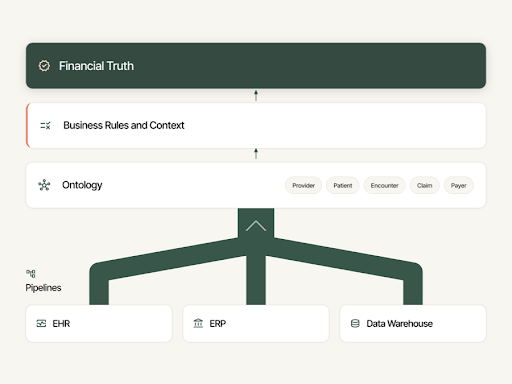
The Translucent ontology categorizes entities and how they connect, creating a shared understanding between humans and agents. A charge belongs to a claim, paid under a contract, for a case in a service line. Then, by defining explicit connections, an AI agent can model sure-footedly, without anyone having built that path in advance.
We pair that structure with your context and business rules, so agents reason about your numbers the way your team does. This painstaking organization also lets us feed an agent only what is relevant to the question in front of it. No extraneous data, no wild exploration. The agent can only see what it should.
Trust in the math
LLMs work by predicting the next word, which is a good way to produce a sentence and a bad way to produce a number. Financial calculation requires auditable equations, so we never leave the math to the model. We route calculations through code, the way a formula in a spreadsheet does. Same inputs, same result every time.
Trust in the answers
Internally, we check every agent output for correctness and style, at scale, with a suite of evaluations. Everything an agent creates is graded against a rubric. Every change to an agent harness or the tools it can use is tested. Every new model release is checked to see where it got better and where it got worse, because updates are not uniformly upgrades.

Evaluation rubrics are written by Translucent subject matter experts. They span revenue cycle management, health economics, financial planning, and more. We solve the hard problem of making something good, by knowing what good looks like.
For users, trust has to be earned. We build citations and explanations into every AI surface so that anyone can sanity-check what they are looking at.
What this buys you
In this series, we’ll dive deeper into each of these failure modes and how AI engineering can solve them. We know trust is the cornerstone of AI adoption.
The prize once trust is established is superhuman intelligence: agents working continuously across every service line, payer contract, and cost center, surfacing opportunities to improve financial health no team has the hours to find. These opportunities arrive already sized and root-caused, with recommended actions attached, and tracebacks to one set of numbers that finance and operations all agree on.
Agent-powered automation lets a finance team shift its effort to the part that will always need a human: deciding what to do, and doing it.